
What is ISO 9001:2015?
ISO 9001 is the world’s most widely recognized standard for Quality Management Systems (QMS).
It is designed to help organizations consistently meet customer and stakeholder requirements by establishing a structured framework for delivering high-quality products and services.
The standard is built on seven quality management principles, including a strong customer focus, leadership involvement, and a commitment to continuous improvement.
Here are the 7 Quality Management Principles:
Customer Focus: The primary goal is to meet and exceed customer expectations.
Leadership: Leaders establish unity of purpose and create conditions for people to engage in quality objectives.
Engagement of People: Competent, empowered, and engaged people at all levels are essential.
Process Approach: Consistent and predictable results are achieved by understanding and managing interrelated processes.
Improvement: A continuous focus on improvement is necessary for an organization to adapt and succeed.
Evidence-based Decision Making: Decisions based on the analysis and evaluation of data and information are more likely to yield desired results.
Relationship Management: Managing relationships with relevant interested parties (like suppliers) contributes to sustained success.
These principles are not in a fixed order of priority, as their importance can vary for each organization and change over time.
Why should you get ISO 9001 certification?
An ISO 9001 certification provides objective proof to your staff, partners, clients and the outside world that customer satisfaction is at the core of your business.
One of the key strengths of ISO 9001 is its flexibility; it can be applied to any organization, regardless of its size, industry, or type of business. Whether it’s a small startup or a large multinational corporation, manufacturing, finance, hospitality, technology or education industry, the standard offers a universal approach to achieving quality excellence.
Industries that ISO 9001 Standard Certifications cover:
ISO 9001 – Quality Management System (QMS)
Purpose: Ensures consistent quality of products/services and customer satisfaction.
Industries Covered:
- Manufacturing (automotive, electronics, machinery, consumer goods)
- Construction and engineering
- Healthcare and pharmaceuticals
- Information technology and software development
- Food and beverage
- Hospitality and tourism
- Education and training
- Retail and logistics
- Aerospace and defense
- Professional services
What are the key benefits of ISO 9001?
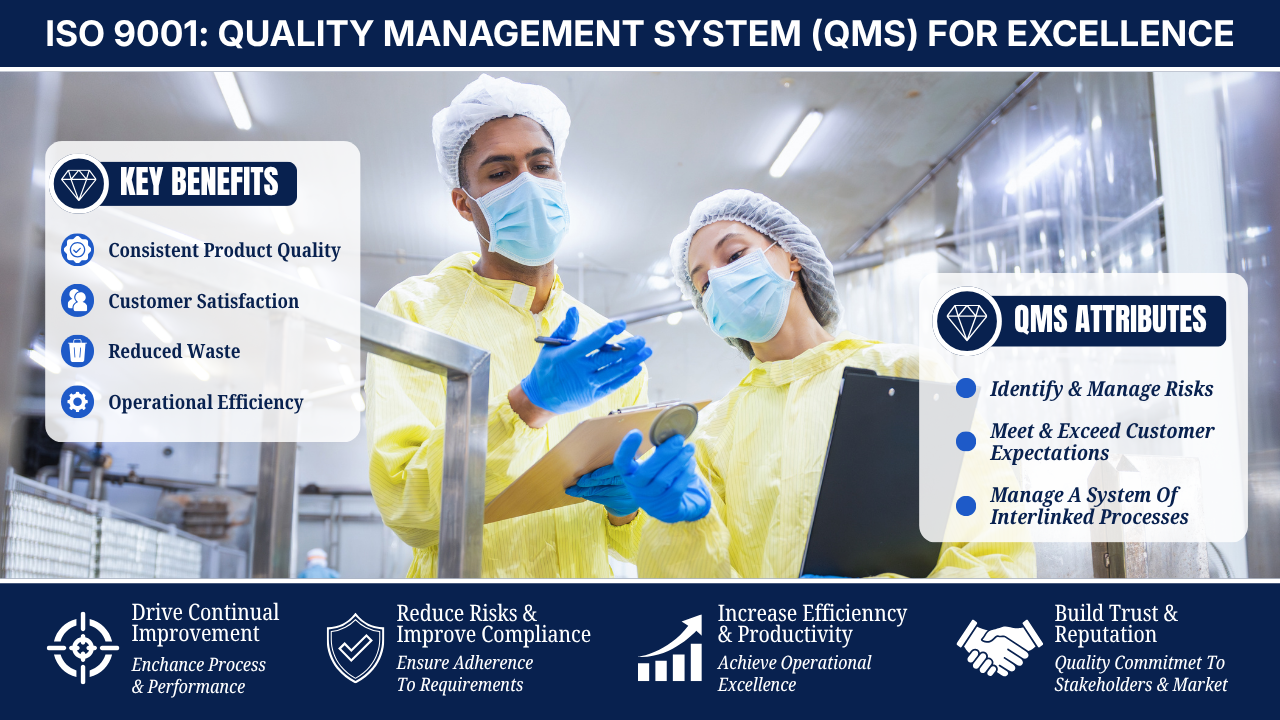
- Customer Satisfaction: Consistently delivering quality products/services that meet expectations builds trust, loyalty, and repeat business.
- Increased Efficiency & Productivity: Standardized processes reduce errors, waste, and unnecessary activities, saving time and resources.
- Cost Reduction: Streamlined operations and better resource use directly lower operational costs.
- Better Decision-Making: Promotes a data-driven approach, using metrics to evaluate performance and make informed choices.
- Risk Management: A proactive approach to identifying and mitigating risks and capitalizing on opportunities.
- Employee Engagement: Clear processes, improved morale, and a sense of pride in delivering quality work boost engagement.
- Competitive Advantage: Stands out from competitors, meets tender requirements, and opens new markets.
- Continuous Improvement: Fosters a culture of regular process reviews and refinements for ongoing growth.
- Global Recognition: International standard signals quality and reliability to global partners.
In essence, ISO 9001 provides a robust Quality Management System (QMS) that helps businesses run more smoothly, satisfy customers better, and achieve sustainable growth.
About the ISO 9001 Certification Process
A consulting company can guide organizations in understanding the best practices of the ISO 9001 standard. Their expertise helps make the process of achieving certification smoother and more effective.
Achieving ISO 9001 certification requires careful planning, dedication, and allocation of resources. Our certification body (QMS) suggests a straightforward three-step process:
- Gap Analysis
A consultant conducted a review of our current processes and procedures, identifying and documenting any areas that do not comply with the standard’s requirements.
- Implementation
Necessary adjustments are made to existing processes and procedures to ensure compliance with the standard.
- Certification
An auditor conducts an annual visit to verify that all documented processes are being properly followed. Once compliance is confirmed, a new ISO certificate is issued.
If you need help with an ISO 9001 audit, new certification, or renewal, feel free to contact HQ TAX & FINANCIAL
ISO 9001 Certification in Chicago – Frequently Asked Questions (FAQ)
Why is ISO 9001 certification important for Chicago businesses?
ISO 9001 certification helps Chicago businesses improve operational efficiency, meet client and regulatory expectations, and compete for contracts that require certified quality management systems. It also demonstrates credibility and commitment to quality.
Which businesses in Chicago can get ISO 9001 certified?
ISO 9001 applies to businesses of all sizes and industries, including manufacturing, logistics, construction, professional services, healthcare, IT, and consulting firms across the Chicagoland area.
Is ISO 9001 certification mandatory?
ISO 9001 certification is not legally mandatory, but many government agencies, large corporations, and international clients require it as a condition for contracts or vendor approval.
How long does it take to get ISO 9001 certification?
The timeline varies depending on company size and readiness. Most Chicago businesses complete ISO 9001 implementation and certification within three to six months with professional consulting support.
What does ISO 9001 certification consulting include?
ISO 9001 consulting typically includes gap analysis, QMS documentation, process mapping, employee training, internal audit preparation, and support through the certification audit process.
Does ISO 9001 certification require an audit?
Yes. Certification requires an independent audit conducted by an accredited certification body. The audit verifies that your quality management system meets ISO 9001 standards and is effectively implemented.
Can small businesses in Chicago get ISO 9001 certified?
Yes. ISO 9001 is scalable and well suited for small and medium-sized businesses. Many Chicago small businesses pursue certification to improve internal processes and qualify for larger contracts.
How much does ISO 9001 certification cost in Chicago?
Costs depend on business size, complexity, and current process maturity. Expenses typically include consulting, documentation, training, and certification body audit fees. A consultation helps determine accurate costs.
Does ISO 9001 certification need to be renewed?
Yes. ISO 9001 certification is valid for three years, with annual surveillance audits required to maintain certification and ensure ongoing compliance.
Will ISO 9001 certification improve business performance?
Yes. Businesses often experience improved efficiency, reduced errors, better customer satisfaction, stronger documentation, and clearer accountability after implementing ISO 9001.
Is ISO 9001 certification recognized internationally?
Yes. ISO 9001 is globally recognized and accepted, making it valuable for Chicago businesses working with international clients or expanding globally.
Do employees need training for ISO 9001?
Yes. Employee awareness and training are critical to successful ISO 9001 implementation. Training ensures staff understand quality objectives, procedures, and their role in maintaining compliance.
Can ISO 9001 be integrated with other ISO standards?
Yes. ISO 9001 integrates well with other standards such as ISO 14001, ISO 27001, and ISO 45001, allowing businesses to build a unified management system.
Does ISO 9001 certification help with audits and compliance?
Yes. A structured QMS improves documentation, traceability, and audit readiness, making regulatory and customer audits more efficient and less disruptive.
Why choose a local ISO 9001 consultant in Chicago?
A local consultant understands regional industries, regulatory expectations, and business practices. Chicago-based ISO 9001 consultants also provide on-site support and faster communication.
How do I start ISO 9001 certification in Chicago?
The first step is a gap analysis to assess current processes against ISO 9001 requirements. From there, a structured implementation plan is developed to achieve certification efficiently.
Why choose HQ Tax & Financial for ISO 9001 consulting in Chicago?
HQ Tax & Financial provides ISO 9001 consulting with a practical, compliance-focused approach. We help Chicago businesses implement effective quality systems that support long-term growth and audit readiness.